You don’t expect to see sky burials in the city – but they’re all around. Burials when the ground is too hard to bury a body, so the culture ceremoniously leaves the deceased out for vultures to pick away at it. It’s the natural order of things, ashes to ashes, dust to dust. Except there is no ceremony in the city.
On Saturday Mark and I came home late, crossing through the alley on a cold night, making some noise as we usually do to scare away any rats. We’ve both had the experience of sneaking up on one, catching him by surprise – once, in the parking lot, I had three little ones race towards me in their game of tag before I screamed and they quickly veered off to the right. Another time, Mark had a big fat one nearly run square into him before it saw a person standing there and took off the other way. This night, coming down the alley, we came up on a big one, a foot from head to butt, lying on its side. It looked to have just died. His fur was clean and brownish grey, his belly white. He was well-fed and strong, and probably poisoned. We rounded it respectfully, though I wanted to take a closer look. It felt disrespectful somehow, to gawk. The next morning he was gone, presumably swept away by maintenance workers.
Yesterday morning while making coffee I looked out to watch the ducks in their precarious premating rituals: one brown female surrounded by five green-headed males, all of them vying for her attention, and as they bathed themselves in the icy water, a dead carp floated by, unnoticed.
This morning I was awoken by the loud screams of sea gulls – a group had gathered on the ice over the river and were pulling apart a dead fish. They have been out there for hours, pulling out sections of its gut, two or three standing guard while one takes its turn at the carcass.
We cannot bury our dead with so much concrete. We go out to the expressway-rimmed suburbs, we cremate and sprinkle the lake. For some reason I am glad to know that sky burials are still a viable option.
20070228


20070219
When All Else Fails...
…Suspend a ceramic space heater down the sewage area and melt the proverbial rat in the snake’s belly.
Mark had the pump-out working in less than an hour, and we had good plumbing again.
Ah, the wonders of outsourcing.
Mark had the pump-out working in less than an hour, and we had good plumbing again.
Ah, the wonders of outsourcing.
20070215
Peeing in a Bucket
Word on the marina was that the pump out was broken. It had been a good two weeks since we pumped out, but when we heard the news from Stan on Sunday, we didn’t take it too seriously. J---, another boater, had tried to pump out to no avail. “Too bad, ‘cause he’s full, too,” Stan said. We agreed. Too bad. And we went on our way.
Monday, we noticed some overflow in the bilge. Probably from the condensation that had formed ice inside the boat and was now melting. It wasn’t very dark. But by evening, it was dark. And smelly. And Tuesday morning, the toilet was resisting when we tried to flush it. Yep – time to pump out.
If pump out was a two-person job before, it’s now even more complicated. While Mark stands on one side of the marina, separated from our boat by water, I toss him one end of a yellow rope, which he ties to the pump out hose, and I drag across the marina to our side. It just reaches the opening to our tank, and I attach it tightly while Mark flips the switch. We communicate by yelling across the marina; if it’s windy, we use cell phones.
But it was still questionable whether the pump out was working. After shoveling a foot of blowing snow off our deck, I tromped over across the marina to the pump out, which was duct-taped and had a sign: “Out of Order Management Called.” When Mark came home, he thought he could still get it to work; he couldn’t. We had a full tank, a nonfunctioning pump out, and a snowstorm so bad that they were canceling university classes.
Mark made some calls. The other boaters all said the same thing. “I’m peeing in a bucket.” He called Captain P---, president of the condo association and supposed marina management. Captain P--- said he outsourced the marina management to a great company – but they’re on vacation for three weeks. He didn’t seem very eager to do anything to help the situation. The hose was probably frozen – just gotta wait till it thaws out. And the fact that temperatures were supposed to drop below zero for the next week? Captain P--- shrugged over the phone. “I’m peeing in a bucket.”
Mark relayed all this to me after he hung up the phone.
I repeated it to make sure I understood. “You mean the condo association president is peeing in a bucket ‘cause he outsourced the job of fixing things and the company he outsourced to is on vacation?”
Mark confirmed this was true. “The entire marina is peeing in a bucket."
We did this before, you know. We went without water when the boat froze, and peed in a bucket, and came up with an ingenious design of a plastic bag in the toilet to catch our solid waste, which we promptly threw out in the same dumpster beside the rats. It’s not like this is new or anything.
“I don’t want to pee in a bucket,” Mark said. “It’s the principle of the thing.”
I asked him if he could just leak the waste into the water. “I’d do it if we were out on the lake, but I don’t want to do it in the marina.”
We discussed the options. There weren’t many. Mark got a scary look in his eye. “How about we just get a shop vac and suck it out? I won’t throw it in the marina, but I’d throw it in the river.”
“Maybe you should sleep on this idea,” I suggested.
Our sewage tank holds 50 gallons. “If we had a 10-gallon shop vac, it’d be ten times flushing it out,” Mark said. “If we had a 20-gallon shop vac, that’d be half of it. You don’t like this idea, do you? C’mon baby, where’s your sense of humor?” But I know he’s not kidding. “Trying to be self-sufficient, too, you know?”
“You don’t have any problems emptying 50 gallons of sewage into the river?” I asked him.
“Hey, it was your idea,” he said, “But I am a member of Friends of the River. I took an oath and all…”
So we're peeing in a bucket. And finding toilets in restaurants, libraries, and office buildings as often as possible. Who knows when this problem will be solved. The trickiest part is, nobody really knows who’s managing the River City marina. River City? The condo association? Captain Pee? Some mysterious outsourced company in India?
The best thing about living on a boat, you’re under the radar. The worst thing about living on a boat? Still under the radar. Just remember to bring your bucket.
Monday, we noticed some overflow in the bilge. Probably from the condensation that had formed ice inside the boat and was now melting. It wasn’t very dark. But by evening, it was dark. And smelly. And Tuesday morning, the toilet was resisting when we tried to flush it. Yep – time to pump out.
If pump out was a two-person job before, it’s now even more complicated. While Mark stands on one side of the marina, separated from our boat by water, I toss him one end of a yellow rope, which he ties to the pump out hose, and I drag across the marina to our side. It just reaches the opening to our tank, and I attach it tightly while Mark flips the switch. We communicate by yelling across the marina; if it’s windy, we use cell phones.
But it was still questionable whether the pump out was working. After shoveling a foot of blowing snow off our deck, I tromped over across the marina to the pump out, which was duct-taped and had a sign: “Out of Order Management Called.” When Mark came home, he thought he could still get it to work; he couldn’t. We had a full tank, a nonfunctioning pump out, and a snowstorm so bad that they were canceling university classes.
Mark made some calls. The other boaters all said the same thing. “I’m peeing in a bucket.” He called Captain P---, president of the condo association and supposed marina management. Captain P--- said he outsourced the marina management to a great company – but they’re on vacation for three weeks. He didn’t seem very eager to do anything to help the situation. The hose was probably frozen – just gotta wait till it thaws out. And the fact that temperatures were supposed to drop below zero for the next week? Captain P--- shrugged over the phone. “I’m peeing in a bucket.”
Mark relayed all this to me after he hung up the phone.
I repeated it to make sure I understood. “You mean the condo association president is peeing in a bucket ‘cause he outsourced the job of fixing things and the company he outsourced to is on vacation?”
Mark confirmed this was true. “The entire marina is peeing in a bucket."
We did this before, you know. We went without water when the boat froze, and peed in a bucket, and came up with an ingenious design of a plastic bag in the toilet to catch our solid waste, which we promptly threw out in the same dumpster beside the rats. It’s not like this is new or anything.
“I don’t want to pee in a bucket,” Mark said. “It’s the principle of the thing.”
I asked him if he could just leak the waste into the water. “I’d do it if we were out on the lake, but I don’t want to do it in the marina.”
We discussed the options. There weren’t many. Mark got a scary look in his eye. “How about we just get a shop vac and suck it out? I won’t throw it in the marina, but I’d throw it in the river.”
“Maybe you should sleep on this idea,” I suggested.
Our sewage tank holds 50 gallons. “If we had a 10-gallon shop vac, it’d be ten times flushing it out,” Mark said. “If we had a 20-gallon shop vac, that’d be half of it. You don’t like this idea, do you? C’mon baby, where’s your sense of humor?” But I know he’s not kidding. “Trying to be self-sufficient, too, you know?”
“You don’t have any problems emptying 50 gallons of sewage into the river?” I asked him.
“Hey, it was your idea,” he said, “But I am a member of Friends of the River. I took an oath and all…”
So we're peeing in a bucket. And finding toilets in restaurants, libraries, and office buildings as often as possible. Who knows when this problem will be solved. The trickiest part is, nobody really knows who’s managing the River City marina. River City? The condo association? Captain Pee? Some mysterious outsourced company in India?
The best thing about living on a boat, you’re under the radar. The worst thing about living on a boat? Still under the radar. Just remember to bring your bucket.
20070214
The Other Live Aboard
I first came to know him in the middle of the night, scampering in the walls. I thought I was dreaming; Mark said I was imagining things. But I couldn’t shake the feelings that we weren’t alone.
He leaves clues after a long night. Like last night. Before going to bed, we turned down the diesel furnace. This morning when we turned it back on, it didn’t work. Fuel pump is intact, everything is the same – but no go. On Saturday, Mark vacuumed up an inch of standing water in the bilge under the bow. We thought maybe it was sewage that had overflown. This morning, it’s back, but not quite so brown, so not sewage. Where’s it coming from? What could have caused these mysterious disturbances?
Fate and chance are too obvious, poltergeist too adolescent. No, we have deduced that it’s the gremlin. We joke that he’s half rabbit, half rat, ostracized by both communities, and at risk of being eaten by the coyote who lives in the trees along the south loop river bank. He’s come to live on Mazurka for safety, lurking about in the darkness of the engine room, and because it amuses him. He’s a trickster – what can he do? Is it his fault he’s surrounded by wires, just waiting to be crossed? Is it his fault the generator is so complex that every night he can tinker with just one more piece, thus eluding the captain from ever figuring out the “real” problem?
We thought maybe the cats would kick him out, but he seems to have struck a deal with them – they pretend to know nothing of his existence, and look the other way when something goes awry. And, as much as I love my cats, I know they’re not smart enough for these top-notch jobs – they’re amused just watching the snow slide down the shrinkwrap.
He’s a bit of a klepto, too, probably due to his feelings of insecurity and lack of stable social network. Somewhere on board he is hoarding flashlights, wrenches, critical O-rings and bolts, and bushels of pens, batteries, hats, and lighters of all variety (he seems overly fond of fire, which sometimes worries me). You’d think in a small space like a boat it would be impossible to hide anything for long – you would be mistaken.
I refuse to appease him by setting out snacks. St. Anthony can handle our pleas for lost items, and I stopped putting out cookies for Santa long ago.
Even if I could get my hands on his jaunty little self, which I know prances around with pride while we struggle and swear at his handiwork, even if I could get ahold of his rabbit foot or his rat tail, I wouldn’t kick him out. I feel for the guy. These shores are tough – between the River City canine community, who spend all day cooped up in Jetson-like apartments and are just itching to sink their teeth into a pokey little gremlin, and the hissing geese who, when they start nesting in about a month, are likely to beat him to death with their wings if he comes within twelve feet of their eggs, well, there’s too many enemies. Not to mention his own kind – the city rats and the country rabbits – who scorn him ‘cause he looks different. I can relate to straddling those two worlds – the urban and the rural – and those of us who don’t fit in neither world gotta stick together.
Just as long as he keeps his paws off the shrinkwrap.
He leaves clues after a long night. Like last night. Before going to bed, we turned down the diesel furnace. This morning when we turned it back on, it didn’t work. Fuel pump is intact, everything is the same – but no go. On Saturday, Mark vacuumed up an inch of standing water in the bilge under the bow. We thought maybe it was sewage that had overflown. This morning, it’s back, but not quite so brown, so not sewage. Where’s it coming from? What could have caused these mysterious disturbances?
Fate and chance are too obvious, poltergeist too adolescent. No, we have deduced that it’s the gremlin. We joke that he’s half rabbit, half rat, ostracized by both communities, and at risk of being eaten by the coyote who lives in the trees along the south loop river bank. He’s come to live on Mazurka for safety, lurking about in the darkness of the engine room, and because it amuses him. He’s a trickster – what can he do? Is it his fault he’s surrounded by wires, just waiting to be crossed? Is it his fault the generator is so complex that every night he can tinker with just one more piece, thus eluding the captain from ever figuring out the “real” problem?
We thought maybe the cats would kick him out, but he seems to have struck a deal with them – they pretend to know nothing of his existence, and look the other way when something goes awry. And, as much as I love my cats, I know they’re not smart enough for these top-notch jobs – they’re amused just watching the snow slide down the shrinkwrap.
He’s a bit of a klepto, too, probably due to his feelings of insecurity and lack of stable social network. Somewhere on board he is hoarding flashlights, wrenches, critical O-rings and bolts, and bushels of pens, batteries, hats, and lighters of all variety (he seems overly fond of fire, which sometimes worries me). You’d think in a small space like a boat it would be impossible to hide anything for long – you would be mistaken.
I refuse to appease him by setting out snacks. St. Anthony can handle our pleas for lost items, and I stopped putting out cookies for Santa long ago.
Even if I could get my hands on his jaunty little self, which I know prances around with pride while we struggle and swear at his handiwork, even if I could get ahold of his rabbit foot or his rat tail, I wouldn’t kick him out. I feel for the guy. These shores are tough – between the River City canine community, who spend all day cooped up in Jetson-like apartments and are just itching to sink their teeth into a pokey little gremlin, and the hissing geese who, when they start nesting in about a month, are likely to beat him to death with their wings if he comes within twelve feet of their eggs, well, there’s too many enemies. Not to mention his own kind – the city rats and the country rabbits – who scorn him ‘cause he looks different. I can relate to straddling those two worlds – the urban and the rural – and those of us who don’t fit in neither world gotta stick together.
Just as long as he keeps his paws off the shrinkwrap.
20070207
Shackleton's Endurance
 Every February Mark's family meets in the Upper Peninsula of Michigan for the Munising Ice Fest, a long weekend of cross-country skiing and climbing frozen waterfalls in subzero temperatures.
You have to really love the cold to want to climb ice. It requires putting on several layers of clothing, procuring the necessary gear (harness, crampons, two pick axes, and a helmet), and hiking out to a frozen waterfall. Walls of ice are unforgiving, and don't much care how fit you are or how far you drive to climb them - they are cold and foreboding and will stand firm no matter how much ice you chip off in your attempt to scale the wall and conquer it.
We were exhilarated Sunday night, driving back to Chicago, counting down the temperatures ("Now it's -8!"), and returned from a weekend climbing ice to find...ice. The Chicago River was virtually frozen over, with geese like new penguins sliding around on the geometric shapes of dark black ice. River City's marina was completely frozen, and ice closed in on Mazurka's hull so that it resembled Shackleton's Endurance at the South Pole in 1915. Inside, cabin temperature was 28 degrees - everything was frozen, including all the faucets, pipes, olive oil, and contents of the fridge. It felt like an abandoned ghost ship, save for Hunter and Leo, their fur puffed up, looking a bit shell-shocked and thirsty - their water dish was a solid block.
We deduced that sometime after Saturday afternoon, the electric heater stopped working, probably when the river temperature became so cold that the water inlet froze and the heater could no longer pull in warm water to heat the boat. The backup furnace, which runs on diesel, also stopped, the fuel tube somehow bent. "This is my worst nightmare," Mark said, and started the engine - the quickest way he could think to start warming things up - and we plugged in space heaters. We heard the terrible crack of a pipe breaking; thankfully it was just the drinking water filter under the sink. Expensive, but not dire. We stayed up till 1 AM, when the cabin temperature had risen to 42 degrees, then went to bed on an ice cold mattress over the water tanks, which were probably frozen, too.
While I love climbing frozen waterfalls as much as the next girl, I like it even more when I know at the end of the day, we're going to hike back to civilization and drive back to the hotel, where there's hot soup and coffee and a sauna and whirlpool. Driving eight hours back to Chicago, I was looking forward to a nice, hot 6-minute shower, some clean clothes, and a warm bed. Instead, we lay down on a block of ice wearing the same three layers of clothing and hats and coats we'd worn all weekend. I tried to be grateful that I had a roof over my head when there were plenty of people sleeping under cardboard. It was all I could do not to break down sobbing. "I feel like throwing up," I told my husband in the darkness. He agreed. It was the first time in four months I thought maybe living on Mazurka wasn't such a great idea.
The next morning we worried about living on board without water. We considered which friends we could stay with. Mark said he would stay on Mazurka to make sure she was okay. My first thought was to put my cats in the car and drive to my parents' house till things heated up, but I thought again - I was married now. I would stick by my husband.
Shackleton told about the sound of ice squeezing the Endurance, locking it in a vice that eventually forced the crew to abandon ship and haul lifeboats across the frozen Antarctic tundra. It was one of these lifeboats that Shackleton and a few crewmembers sailed on an amazing voyage to get help and save the entire crew.

I doubt any of that crew ever forgot what it was like to walk away from the Endurance, abandoning her to the ice.
"What's the worst that could happen?" I asked.
"A pipe could burst and the boat would fill with water and sink."
We kept the engine running and space heaters cranked while I drove Mark to work and bought two more space heaters. By mid-morning we were up to 50 degrees. Mark came home just after noon and built a contraption off the dock to suspend the de-icer - a large bubbling fan - beneath the bow of the boat, which began churning the water, fighting the ice from squeezing the hull and potentially cracking it. For fun, and because it looked possible, I decided to test the strength of the ice off the stern and stepped right from the swim deck onto the ice. It held. Cabin temperature kept rising. By late afternoon the pipes had thawed and we had water again, but drains stayed frozen. We decided it was safe to turn off the engine.
That night, we slept in a warm bed, listening to the reluctant moan of ice as it released its grip on our home.
By Tuesday afternoon, cabin temperature was 71 degrees, and we had hot water and functional plumbing again. The de-icer had cleared all the ice from the boat. Hunter and Leo basked in their new sources of heat. Outside, it snowed and windchill remained below zero. By Wednesday, we were floating again.
When I told my friend Anne our adventures, she laughed. "Instead of trial by fire, you're going through trial by ice!"
20070205


20070131
In the Belly of the Whale

Newlyweds study a new language - the looks of their beloved. It starts with the "Wow we're in love - who knew the world could be so wonderful" look and the "I can't believe someone as amazing as you exists" look and evolves to include the "Just got home from a rotten day" look and the "I don't know how to fix this thing but I'm going to keep trying till it kills me" look.
One of Mark's more foreboding looks is the Saturday Morning look. Foreboding because I never know what it will lead to - running errands? going to a movie? pulling apart the entire engine room to paint the floor?
One thing for sure - it will involve me.
Like the Saturday before we left for our honeymoon in December. The final task to prepare the boat for winter was to shrinkwrap the top. Shrinkwrapping, in essence, is wrapping the boat in thick plastic, then taking a blowtorch to the plastic to seal it down tight. It keeps the boat warm, protects it from the elements, and eliminates the need to shovel snow. It's also the annual winter feat for live-aboards, who try to outdo their work from the last year, and the work of their neighbors. Some wrap the entire boat in plastic and build a door. Others, like Mark, just wrap the top and leave the windows clear. Last December it snowed early and Mark stayed up all night to build the structure and shrinkwrap the boat. It didn't snow for the rest of the year, and he fought the thing all winter, patching holes and struggling to save it from caving into the wind.
This year, Mark had a new improved plan to build the structure. Of course, plans are always slightly ambiguous in his mind, and in less than an hour, he had me outside, holding PVC tubing while he torched the middle to curve it, all part of an elaborate crown design for the fly bridge. By mid-afternoon when our friend Dennis arrived to help, it was pretty clear there was no way PVC tubing was strong enough to suspend the heavy plastic, and we went with a simple yet effective revision: five tall saw-horses, hinged at the top, built on six-foot 2x4s, three atop the fly bridge, one at the bow, one at the stern. The design was perfect in its simplicity; neighbors came out to applaud.
But we spent so much time on the structure that we ran out of time to actually wrap the boat in plastic. We flew to Rome for our honeymoon, spent another week in the Dolomites, where they were trucking in snow for skiers. The talk everywhere was of Global Warming. We returned home on New Year's Day to a balmy 50 degrees.
To wrap or not to wrap? Mark asked my opinion; I told him I thought it was a waste of time. "Of course, it could drop below zero next week," I said. "This is Chicago."
So the next Saturday, a spring-like day in early January, Mark was out testing the blowtorch before I was even out of bed. Soon I heard him calling from the dock, "Can you come out here a second? I just need you to...."
Ten minutes later, I'm dressed and standing on the fly bridge. Mark is perched on the dock in front of the boat, a four-foot roll of plastic balanced across two deck chairs before him. Slowly, he unrolls the plastic, sending it up to me and down the back until the entire boat is draped in a thick white blanket The air around me is still, quiet, the sounds of downtown muffled; I felt like Jonah, peaceful and safe in the belly of the whale. This isn't so bad, I thought. I like helping my husband...
And then, as it often does in Chicago, the wind changed course and a frigid gust blew up the river, up under my secure blanket of plastic, and suddenly I was holding for dear life onto a parachute I could not control. It turned under like a tidal wave, while I fought to keep the plastic from diving into the river water and taking me with it. Below on deck, Mark raced around, trying to secure the plastic under the white strapping around the perimeter of the boat. But as soon as he tucked up one side, the other side blew out. Stan appeared - "I couldn't watch you guys do this for much longer," he said - and he and Mark taped the plastic to the sides of the boat while I steadied the top. Once it was secure, Mark strapped the blowtorch to a gaff and within the next few hours the entire marshmallow top was heated and sealed down tight - and not a single bit singed.
And now? We are nice and toasty inside this igloo, and good thing, too, 'cause the temperature has dropped to the single digits again. Mark cut a zip-door in back so we can reach the cooler, and the top stays tight, even when the wind blows, while elsewhere in the marina, plastic is blowing off boats like abandoned kites.
And my husband's Saturday morning looks have changed to a lighter variety - last week it was, "Let's go score some scalped tickets to the opera."
20070128


20061212

20061210
The Great Equalizer
The last week of November was 60 degrees. Mark and I rode a motorcycle back from the Upper Peninsula of Michigan, it was so warm. And then, it got cold. And the wind blew. And it got even colder.
How cold? My toothpaste was so stiff I couldn't squeeze it out. Cabin temperature fell to 52 degrees. The electric heater hummed nonstop; the gas-fueled furnace still wasn't working. Are we waiting for a pump still? The last one was defective. When it comes in the mail maybe Mark will be able to fix the furnace, maybe not. In the meantime, he is putting plastic over all the windows to stop the draft. Cabin temperature rises to 55 degrees. But maybe it's all the body heat inside.
The pump comes, the furnace still doesn't work. Mark deduces through phone calls to manufacturers in Anchorage that the motherboard is broken.
The guys in Anchorage take pity on him and sell him another furnace at cost. It'll be here in a few days.
The cats sleep under the covers with us. We keep space heaters beside the bed.
Cabin temperature hovers between 52-60 degrees, when the sun is shining. Outside, it's 12 degrees; windchill is -1.
My friends are concerned - everyone in the city is cold now. "How's life on the boat?" they ask, prepared to offer their place as refuge.
My dear friend and running partner - who just bought a place in a gold coast gated community where the mayor's brother reportedly lives - has four floors and lots of windows and when I tell her the cabin temperature is 58, she says, "That's what we're keeping our place. Who would have thought they put single-plated glass in that place? Single-plated glass! It would cost a fortune to heat it. I don't even want to take a shower it's so cold."
Winter in Chicago is the great equalizer. Doesn't matter if you've got a posh place in the gold coast, a boat on the river, or a piece of cardboard under the Webster Street overpass: if you're cold, you're cold you're cold. The most any of us can hope for is a warm place to sleep tonight.
How cold? My toothpaste was so stiff I couldn't squeeze it out. Cabin temperature fell to 52 degrees. The electric heater hummed nonstop; the gas-fueled furnace still wasn't working. Are we waiting for a pump still? The last one was defective. When it comes in the mail maybe Mark will be able to fix the furnace, maybe not. In the meantime, he is putting plastic over all the windows to stop the draft. Cabin temperature rises to 55 degrees. But maybe it's all the body heat inside.
The pump comes, the furnace still doesn't work. Mark deduces through phone calls to manufacturers in Anchorage that the motherboard is broken.
The guys in Anchorage take pity on him and sell him another furnace at cost. It'll be here in a few days.
The cats sleep under the covers with us. We keep space heaters beside the bed.
Cabin temperature hovers between 52-60 degrees, when the sun is shining. Outside, it's 12 degrees; windchill is -1.
My friends are concerned - everyone in the city is cold now. "How's life on the boat?" they ask, prepared to offer their place as refuge.
My dear friend and running partner - who just bought a place in a gold coast gated community where the mayor's brother reportedly lives - has four floors and lots of windows and when I tell her the cabin temperature is 58, she says, "That's what we're keeping our place. Who would have thought they put single-plated glass in that place? Single-plated glass! It would cost a fortune to heat it. I don't even want to take a shower it's so cold."
Winter in Chicago is the great equalizer. Doesn't matter if you've got a posh place in the gold coast, a boat on the river, or a piece of cardboard under the Webster Street overpass: if you're cold, you're cold you're cold. The most any of us can hope for is a warm place to sleep tonight.
20061120
The Economy of Space
It's amazing how much stuff you don't actually need. Donate all your furniture. Throw out the old Valentine's cards and college term papers. Get rid of most of your kitchen stuff, except what's really important to you, or was important to your great-grandmother. Leave stuff in the alley and it'll be gone in ten minutes. Give away three-quarters of your clothing - do you wear all of it, anyway? - and put next season's stuff in storage. In all, I walked away from 14 years of adult life with a dozen Rubbermaid containers. They are well-organized in a storage unit downtown by the bus station, beside Mark's motorcycle. I have less stuff now than when I left for college.
You know what? I don't miss all that crap one bit.
You know what? I don't miss all that crap one bit.
The Mayor of River City
The Lake region doesn't take too kindly to winter boaters - the last remaining harbors are closing their docks, shutting off their water, making it generally impossible for somebody to stay all year if they choose. River City just south of the loop is one of the last homes for the winter boaters - those few renegades whose love of boating goes beyond drinking and riding the waves and getting sunburned. The diehards. The Live Aboards.
River City is not as pretty as Monroe or Belmont harbors. The lakefront is much more regal, much cleaner thanks to all the zebra mussels. People dump all kinds of shit into the river, even though Friends of the River has a plan that it be swimmable by 2015. (It's almost 2007 and you're not supposed to let the river water touch your skin.) As my friend Kathy pointed out, "You could dump a body back here and nobody would know." And I'm sure they do, in between the dark docks and mysterious lines, along with all kinds of industrial waste and other impossible-to-place-garbage. Last spring I saw floating the small carcass of an unidentifiable animal - was it a lizard? an oversized tadpole?
This winter, River City is housing eight boats with Live Aboards.
We are an ecclectic crew: a suburban PE teacher, an NPR addict, a City of Chicago union worker and his girlfriend, an IRS employee, a dentist, an engineer planning for retirement and sailing the world, and overseeing us all, the unofficial mayor: Stan the Man.
Stan the Man is Irish, usually drunk, though you'd never know it if you stayed out of breath-shot. He worked as a handyman with travelling carnivals for a while amidst other unknown careers. How he ended up in Chicago living on a nameless Chris-Craft I don't know. He is the kind of guy who lives under the radar, always attached somehow to the main action; the kind of guy you believe has connections to politicians and mobsters, if only because he's willing to do the dirty work at the last minute and take the cash without asking questions.
He's also kind, friendly, and warm, keeps Rice Krispies on his boat, along with mirrored letters on his door that spell out STN. When we had to move Mark's boat in subzero temperatures last January, Stan was the first to arrive to help. When a boat arrives in River City, he is right there to take your lines. When we returned recently from a trip and sent Mark's brother ahead with some things for the boat, Stan was right there asking him who he was and why he was aboard Mazurka.
One night after midnight Mark and I came home to a quiet River City. We rounded the gates and passed noiselessly along the dock's corridor (though making enough noise to scare away any rats). The water was quiet and still; the only sound was a subtle steam coming from the post office across the river. As we passed Stan's Chris-Craft, there was the sudden unmistakable howl of Roger Daltrey, followed by Stan's cry: Won't get fooled again!
Every neighborhood has its unofficial mayor: the old Japanese painter who sits on his front porch and chats it up; the retired black gentleman who sweeps his walk and smokes cigars; the Irishman who always magically appears whenever you need to slide into a slip and tie up your home.
What we all need is a mayor who's rocking on out to The Who.
River City is not as pretty as Monroe or Belmont harbors. The lakefront is much more regal, much cleaner thanks to all the zebra mussels. People dump all kinds of shit into the river, even though Friends of the River has a plan that it be swimmable by 2015. (It's almost 2007 and you're not supposed to let the river water touch your skin.) As my friend Kathy pointed out, "You could dump a body back here and nobody would know." And I'm sure they do, in between the dark docks and mysterious lines, along with all kinds of industrial waste and other impossible-to-place-garbage. Last spring I saw floating the small carcass of an unidentifiable animal - was it a lizard? an oversized tadpole?
This winter, River City is housing eight boats with Live Aboards.
We are an ecclectic crew: a suburban PE teacher, an NPR addict, a City of Chicago union worker and his girlfriend, an IRS employee, a dentist, an engineer planning for retirement and sailing the world, and overseeing us all, the unofficial mayor: Stan the Man.
Stan the Man is Irish, usually drunk, though you'd never know it if you stayed out of breath-shot. He worked as a handyman with travelling carnivals for a while amidst other unknown careers. How he ended up in Chicago living on a nameless Chris-Craft I don't know. He is the kind of guy who lives under the radar, always attached somehow to the main action; the kind of guy you believe has connections to politicians and mobsters, if only because he's willing to do the dirty work at the last minute and take the cash without asking questions.
He's also kind, friendly, and warm, keeps Rice Krispies on his boat, along with mirrored letters on his door that spell out STN. When we had to move Mark's boat in subzero temperatures last January, Stan was the first to arrive to help. When a boat arrives in River City, he is right there to take your lines. When we returned recently from a trip and sent Mark's brother ahead with some things for the boat, Stan was right there asking him who he was and why he was aboard Mazurka.
One night after midnight Mark and I came home to a quiet River City. We rounded the gates and passed noiselessly along the dock's corridor (though making enough noise to scare away any rats). The water was quiet and still; the only sound was a subtle steam coming from the post office across the river. As we passed Stan's Chris-Craft, there was the sudden unmistakable howl of Roger Daltrey, followed by Stan's cry: Won't get fooled again!
Every neighborhood has its unofficial mayor: the old Japanese painter who sits on his front porch and chats it up; the retired black gentleman who sweeps his walk and smokes cigars; the Irishman who always magically appears whenever you need to slide into a slip and tie up your home.
What we all need is a mayor who's rocking on out to The Who.
20061116
Safe Harbor
We were supposed to leave our autumn home in Belmont Harbor on November 15th. The same day Japan was bracing for a great tsunami. That night, we drove home from work with two of our friends. It was windy all day, but not till we hit Lake Shore Drive and saw the lakefront like a pail of water lugged by a three year-old did we realize just how windy it was.
We tried to convince ourselves it wasn't that bad - as waves crashed against the shore and shot twenty feet into the air. In the safety of Belmont Harbor, Mazurka rocked back and forth. I worried that the City of Chicago would fine us for staying in the harbor past the leave date. We listened to the weather report, we hemmed and hawed - none of the other straggling boats in the harbor seemed in a hurry to get outta Dodge.
"I'm claiming Safe Harbor," Mark declared.
Who knew there was such a thing? But maybe because large bodies of water are the last wild frontiers - gale force winds can come up in an instant...runaway thunderstorms...pirates.... As we sat around the table that night drinking wine and eating dinner, Mark told us of his uncle sailing Lake Michigan when a storm came up. He parked his boat at the Great Lakes Naval Station, claiming safe harbor, and even though civilian boats aren't allowed there, they had to let them in.
What a concept: If you are in trouble, they have to let you in.
Mazurka carries with her an aura of safety no matter where she goes, even the shady south loop. She has a security system, but it's more for nautical purposes; she has her own phone line and will call Mark if she starts to sink, or leak fuel, or if someone tries to break in, I suppose - but who's going to board a boat docked in the middle of Lake Michigan? We have a lock for it - a thick padlock in the shape of a man, his crotch the keyhole. And every morning when we leave for work we lock her up. But if someone really wanted to get on board, they could. Downtown Chicago, where thieves will break your car window just for the change in the cup holder, but boats are left untouched.
There's a mystery to boats. "People are intimidated by them," Mark says.
Like we were with the gale force winds that night. The lake is 17-22 feet deep along the course we would sail to River City. With 14 foot waves...that made for a rather shallow bottom for the keel on this ship. We stayed put for four more days, till the smooth sailing of the weekend.
And the great tsunami of Japan? 6 foot waves.
Wimps.
We tried to convince ourselves it wasn't that bad - as waves crashed against the shore and shot twenty feet into the air. In the safety of Belmont Harbor, Mazurka rocked back and forth. I worried that the City of Chicago would fine us for staying in the harbor past the leave date. We listened to the weather report, we hemmed and hawed - none of the other straggling boats in the harbor seemed in a hurry to get outta Dodge.
"I'm claiming Safe Harbor," Mark declared.
Who knew there was such a thing? But maybe because large bodies of water are the last wild frontiers - gale force winds can come up in an instant...runaway thunderstorms...pirates.... As we sat around the table that night drinking wine and eating dinner, Mark told us of his uncle sailing Lake Michigan when a storm came up. He parked his boat at the Great Lakes Naval Station, claiming safe harbor, and even though civilian boats aren't allowed there, they had to let them in.
What a concept: If you are in trouble, they have to let you in.
Mazurka carries with her an aura of safety no matter where she goes, even the shady south loop. She has a security system, but it's more for nautical purposes; she has her own phone line and will call Mark if she starts to sink, or leak fuel, or if someone tries to break in, I suppose - but who's going to board a boat docked in the middle of Lake Michigan? We have a lock for it - a thick padlock in the shape of a man, his crotch the keyhole. And every morning when we leave for work we lock her up. But if someone really wanted to get on board, they could. Downtown Chicago, where thieves will break your car window just for the change in the cup holder, but boats are left untouched.
There's a mystery to boats. "People are intimidated by them," Mark says.
Like we were with the gale force winds that night. The lake is 17-22 feet deep along the course we would sail to River City. With 14 foot waves...that made for a rather shallow bottom for the keel on this ship. We stayed put for four more days, till the smooth sailing of the weekend.
And the great tsunami of Japan? 6 foot waves.
Wimps.
20061113
Cheek to Cheek
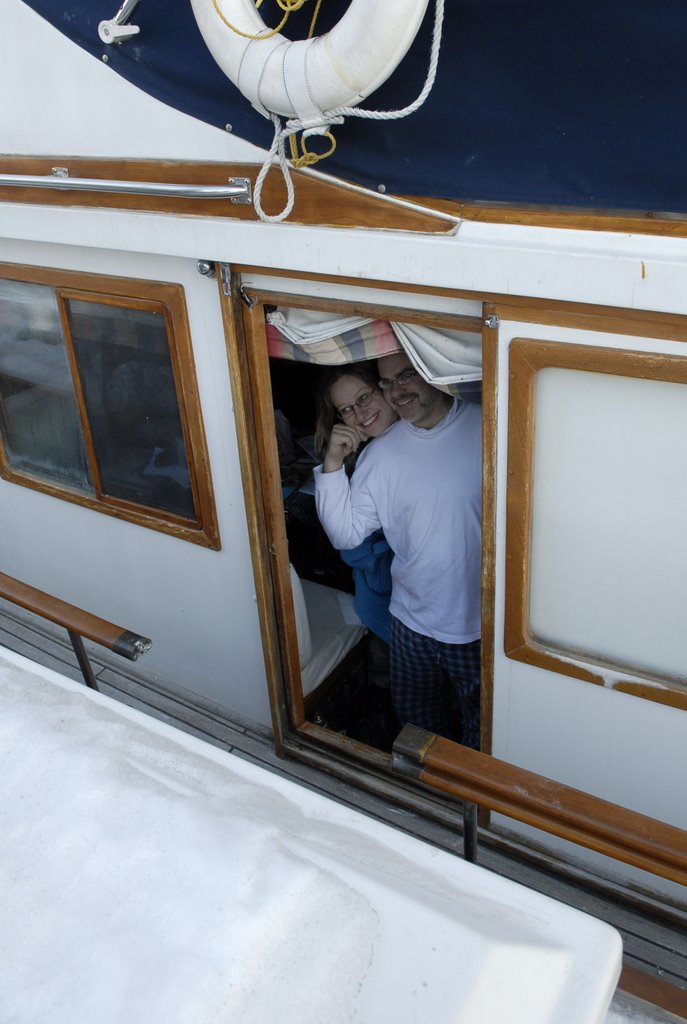
I visited my friend - a great photographer with a long white beard - in his basement studio. As unusual as he is, he is perplexed by my living aboard a boat. "Isn't it cramped?" he asks. "Don't you feel like you're right on top of each other?"
I look around his studio, only a bit smaller than Mazurka. "Well, there's different levels," I explain. "And I have a room and bathroom in the front. I can work up there. It doesn't really feel crowded - it feels like we're outside."
Surrounded by windows - the reason Mark bought a trawler to live aboard - you are always acutely aware of the nature around you, even in the city. Each morning, the first thing you notice is the sky - is it sunny or gloomy? Is the lake filled with fog shrouding the downtown skyscrapers (as it was this morning)? You may go to work in a building with few windows, but all day you know what outside is like, and you return to it at night.
You wake up to water, you fall asleep to water. There isn't a day I approach Mazurka when I don't zip my pockets and clutch the keys close to my chest for fear of losing them to the bottom of Lake Michigan.
And you learn to be economical with your space. The first thing I did in my new role as "wife" aboard Mazurka was rearrange the kitchen. I removed the microwave that required eleven minutes to heat a can of soup. I cleared the pantry shelf and threw away half-used packets of meat seasoning and instant coffee from Thailand. I organized the counter and put everything within easy reach. The lack of space necessitates shopping two or three times a week, which means fresher food, less waste. We have a dorm-sized refrigerator, and a large cooler outside, where I store vegetables and yogurt. A shelf two feet wide and two feet deep serves as our main pantry, with cereals, fruit, crackers, coffee, and cat food. And the squat shelf above the plates and cups holds cans of soup and extra spices.
Boating magazines always include cooking articles, and it seems that boaters latch onto one item they really like - a pressure cooker, a crock pot - and use it for everything. The previous owners left behind a breadmaker and Mark makes killer chocolate pumpernickle cornbread. But our true staple is the grill - a fantail off the stern, fueled by good ole propane.
As little space as we seemingly have, we're having some fantastic meals. Grilled hamburger, sauteed mushrooms, onions, peppers, edamame, salad, and Spanish red wine. Grilled vegetables (zucchini, squash, onions, potatoes) and ribeye steak, and for dessert apples sprinkled with Chinese cinnamon, cheddar cheese, and white port. We cook together, and we clean up together.
The thing I didn't explain to my friend is that, for the few hours we spend aboard Mazurka each day, it's not enough. Maybe it's because we're newlyweds, but I only want to be five feet away from Mark at any given time. Even if he's sitting at his computer, or reading the Wall Street, paying absolutely no attention to me at all. Mark can take apart the entire boat trying to fix the furnace while I sit in the midst of it all writing letters. We are learning to be in each other's space - which we will do for the rest of our lives; we are learning to waltz cheek to cheek.
20061110
Water, Water Everywhere...
To provide hot water for your shower, your dishwasher, and your clothes washer - perhaps all three run simultaneously! - the average house these days boasts a hot water heater that holds 30, maybe even 50 gallons of hot water.
The hot water heater aboard Mazurka holds six.
Yes, six. Six gallons. Take that gallon of ice cream in your deep freeze, that gallon of milk in your jumbo refrigerator and multiply it by six. That's the most hot water there is at any given time.
If you are a man with little hair, you can take a quick shower and be done with it. But you can see how this would be a problem if you were, say, a woman with long, fine hair - very fine hair - which requires two rounds of conditioner. And if you were a woman who, though not a regular leg-shaver, periodically used a razer to clean things up. You can see how this particular woman might be screaming three-quarters into her shower, and then begin to avoid showering on the boat altogether.
"I can just go to the gym," she tells her husband.
So her new husband, wanting to please his new wife, begins to search for alternatives. A new water heater - a cylinder that holds 12 gallons, a cube that holds 10. The cube is a great price on clearance but won't fit in the engine room without knocking a hole in the wall; the 12 gallon heater costs $1400.
"I can just go to the gym" she says again.
And so she does. Monday morning, she's there to swim, then enjoy the long, hot shower. But as she steps under the nozzle...it's cold. Ice cold.
Water, water everywhere - and none of it hot.
The hot water heater aboard Mazurka holds six.
Yes, six. Six gallons. Take that gallon of ice cream in your deep freeze, that gallon of milk in your jumbo refrigerator and multiply it by six. That's the most hot water there is at any given time.
If you are a man with little hair, you can take a quick shower and be done with it. But you can see how this would be a problem if you were, say, a woman with long, fine hair - very fine hair - which requires two rounds of conditioner. And if you were a woman who, though not a regular leg-shaver, periodically used a razer to clean things up. You can see how this particular woman might be screaming three-quarters into her shower, and then begin to avoid showering on the boat altogether.
"I can just go to the gym," she tells her husband.
So her new husband, wanting to please his new wife, begins to search for alternatives. A new water heater - a cylinder that holds 12 gallons, a cube that holds 10. The cube is a great price on clearance but won't fit in the engine room without knocking a hole in the wall; the 12 gallon heater costs $1400.
"I can just go to the gym" she says again.
And so she does. Monday morning, she's there to swim, then enjoy the long, hot shower. But as she steps under the nozzle...it's cold. Ice cold.
Water, water everywhere - and none of it hot.
20061103
Urban Fisherman
There is no shortage of wildlife in the city. Rats, pigeons and squirrels. Ducks and geese. Opossum and bats. One morning on the way to the car Mark tossed our garbage in a dumpster. "There's a raccoon asleep in there," he said. "Wanna see it?" He lifted the lid as I carefully approached. There, atop some newspaper, slept a 40 pound raccoon, curled like a cat. He raised his head, assessing us with black, beady, un-cat-like eyes. "He should be happy," Mark said, closing the lid. "I just gave him half a pound of hamburger."
And, of course, there are fish.
I grew up on the Mississippi River, learning to fish the backwaters at the junction of Illinois, Iowa, and Wisconsin. We caught far too many blue gill, the occasional illusive, coveted walleye, a lot of gar one season (the long-snouted heads of which my brother Jim strung across the front of the camper like some scene from Heart of Darkness), but mostly, we caught crappie - strong, good-natured, good-eating crappie, which Dad and Jim cleaned and piled into the deep freeze for us to eat all winter. One of my best memories growing up is fishing at dusk during mayfly season, when the wispy carcasses of mayflies speckled the water, and crappie leapt up to eat them. We caught our fill that night before the sun went down; our poles barely cast before there was a bite.
When you catch a fish on the backwaters of the Mississippi, you catch in solitude, with only the turtles and woodpeckers to cheer you on, until you return at dusk with a basketful, and then, at the fish cleaning house, the less fortunate gather round to gawk over your catch and slyly inquire where you found them. If you are like my father, you are polite and smile and chat away, but never reveal the sacred spots you have worked so hard to find. Though you might throw them a little bone of a place, if they won't get too tangled in the sunken trees.
In the city, there is always an audience (for anything you do, don't forget). On the first day of October, Jim, Mark, and I watched a fisherman just south of Shedd Aquarium spend twenty patient minutes hauling in a 15 pound salmon. By the time he brought it to shore, a crowd of thirty had gathered to watch, and we applauded.
The salmon come to spawn in Chicago from September to November, and the urban fishermen are out in full force to meet them. They gather along the lakeshore before sun-up, in camo pants and down jackets, jumping fences and ignoring the no fishing within 100 feet of boats signs. They linger till long after the sun is set. I see them when I leave for work in the morning, I see them when I come home. They stir in me some quiet, biological need to catch the fish that swim beneath my home.
One evening, gliding into the pump out station, I motion for the three fishermen gathered around the sewage tank to move aside. "We're coming to pump out," I called to them. They stood a ways off, while I leapt onto the dock and scrambled to tie up. (Definitely not boaters - boaters will always help you tie up.)
I introduced myself to Keith and Sheryl (all fishermen I have known have a girlfriend named Sheryl) and Sheryl's kid Ricky. A few days back Keith caught a couple good-sized salmon - 12, 14 pounds - had them smoked and ate them. I asked if he was concerned about the mercury. He held his hand out in front of him. "Well, I can kinda see straight," he joked. Sheryl joined in. "I was scared, but I ate some. So if we're messed up, at least we're messed up together!" They told me about someone who had caught a northern in Montrose Harbor the previous week - maybe three feet long - "good enough to get in the paper."
I called Jim, a fisherman by vocation, like our dad. "The best thing to do is see what everybody else is doing, then do that. They're probably fishing with roe," he said, before I even described the mass of orange fish eggs sprawled all over the sidewalk. "Is that like sushi?" I asked. "Sort of. They wrap it in small nets to keep it sturdy." Then he thought for a moment. "But if everybody else is fishing with roe, you might try throwing a night crawler out there - they might be itching for something different."
A few days later he called to see how the fishing was. I confessed I didn't feel like doing it in the cold rain. "Go get some sardines from a bait shop," he said. "Not the ones in the store - the frozen ones. They're a real greasy, oily fish - the salmon'll be all over that. Just put one on your line and go inside where it's warm. Hell, you could even put a line out in the morning, then when you get home at night check it. You might have a salmon hanging off your hook."
Because it's in my blood, I'll try it. But I have to admit, it feels wrong to fish for an animal I won't eat for all the mercury we've injected in its blood. I prefer them alive, unseen, quietly swimming beneath my pillow while I dream at night.
And, of course, there are fish.
I grew up on the Mississippi River, learning to fish the backwaters at the junction of Illinois, Iowa, and Wisconsin. We caught far too many blue gill, the occasional illusive, coveted walleye, a lot of gar one season (the long-snouted heads of which my brother Jim strung across the front of the camper like some scene from Heart of Darkness), but mostly, we caught crappie - strong, good-natured, good-eating crappie, which Dad and Jim cleaned and piled into the deep freeze for us to eat all winter. One of my best memories growing up is fishing at dusk during mayfly season, when the wispy carcasses of mayflies speckled the water, and crappie leapt up to eat them. We caught our fill that night before the sun went down; our poles barely cast before there was a bite.
When you catch a fish on the backwaters of the Mississippi, you catch in solitude, with only the turtles and woodpeckers to cheer you on, until you return at dusk with a basketful, and then, at the fish cleaning house, the less fortunate gather round to gawk over your catch and slyly inquire where you found them. If you are like my father, you are polite and smile and chat away, but never reveal the sacred spots you have worked so hard to find. Though you might throw them a little bone of a place, if they won't get too tangled in the sunken trees.
In the city, there is always an audience (for anything you do, don't forget). On the first day of October, Jim, Mark, and I watched a fisherman just south of Shedd Aquarium spend twenty patient minutes hauling in a 15 pound salmon. By the time he brought it to shore, a crowd of thirty had gathered to watch, and we applauded.
The salmon come to spawn in Chicago from September to November, and the urban fishermen are out in full force to meet them. They gather along the lakeshore before sun-up, in camo pants and down jackets, jumping fences and ignoring the no fishing within 100 feet of boats signs. They linger till long after the sun is set. I see them when I leave for work in the morning, I see them when I come home. They stir in me some quiet, biological need to catch the fish that swim beneath my home.
One evening, gliding into the pump out station, I motion for the three fishermen gathered around the sewage tank to move aside. "We're coming to pump out," I called to them. They stood a ways off, while I leapt onto the dock and scrambled to tie up. (Definitely not boaters - boaters will always help you tie up.)
I introduced myself to Keith and Sheryl (all fishermen I have known have a girlfriend named Sheryl) and Sheryl's kid Ricky. A few days back Keith caught a couple good-sized salmon - 12, 14 pounds - had them smoked and ate them. I asked if he was concerned about the mercury. He held his hand out in front of him. "Well, I can kinda see straight," he joked. Sheryl joined in. "I was scared, but I ate some. So if we're messed up, at least we're messed up together!" They told me about someone who had caught a northern in Montrose Harbor the previous week - maybe three feet long - "good enough to get in the paper."
I called Jim, a fisherman by vocation, like our dad. "The best thing to do is see what everybody else is doing, then do that. They're probably fishing with roe," he said, before I even described the mass of orange fish eggs sprawled all over the sidewalk. "Is that like sushi?" I asked. "Sort of. They wrap it in small nets to keep it sturdy." Then he thought for a moment. "But if everybody else is fishing with roe, you might try throwing a night crawler out there - they might be itching for something different."
A few days later he called to see how the fishing was. I confessed I didn't feel like doing it in the cold rain. "Go get some sardines from a bait shop," he said. "Not the ones in the store - the frozen ones. They're a real greasy, oily fish - the salmon'll be all over that. Just put one on your line and go inside where it's warm. Hell, you could even put a line out in the morning, then when you get home at night check it. You might have a salmon hanging off your hook."
Because it's in my blood, I'll try it. But I have to admit, it feels wrong to fish for an animal I won't eat for all the mercury we've injected in its blood. I prefer them alive, unseen, quietly swimming beneath my pillow while I dream at night.
20061031
Hunter the Sailor Cat
We smuggled them away in the dark of night. Swooped them into the carrier, brought the food and litter box and made our way for the harbor.
Hunter and Leo - two brothers with long white hair and orange spots - came from the anti-cruelty society eleven years ago, when they were just six weeks old. They have all their claws, most of their teeth, some extra meat on their bones, and have never been outside.
It's hard to tell which one is the alpha cat. Leo is more agile, more adventurous, more likely to pick on his brother. Hunter likes to lounge around and get his belly rubbed, and doesn't always cover his shit in the litter box.
Cats have lived on board boats for centuries - they guard against rats. But I was skeptical these city cats would actually survive Mazurka.
The first night we let them out on deck, where they roamed for just a bit before making their way for the door. Hunter plopped in the middle of the bed. "So this is where you've been spending all your time," he seemed to say, and started purring. Leo retreated to a cupboard.
The following afternoon, in the brief window of sunlight, we brought them up to the fly bridge. Leo crouched low, mewing, uncertain of the rocking or his footing, and returned to the cupboard. But Hunter stood tall on the fly bridge, surveying the harbor, the wind blowing his fur back. He looked like a true sailor cat, worthy of the high seas.
You never know how living on the water will change somebody - even a loafing eleven year-old cat.
But sympathy pains got to him, and pretty soon, Hunter started hiding in the cupboard with his brother. Every unfamiliar sound frightened them. When I came home from work, they stayed hidden away, rather than greeting me at the door. They hovered low to the ground, ate thought they weren't pestering me for food as usual, and they ceased scrapping in the middle of the night. I worried they would never get used to boat life, even in a placid harbor.
Then one evening we started the engine and took the boat for a ride. I was certain this would send them over the feline psychological edge. They stayed in their cupboard the whole trip. Except at the end, Leo emerged slowly, with a familiar glint in his eye. We took him up to the fly bridge, by the wheel, and he started to purr. He was just waiting to be captain.
Since then, they are back to their old troublemaking selves, as if they've lived aboard Mazurka their entire lives.
I can see now why cats and boats go together. Besides the teams of mice and rats to chase, there's the maze of shelves and levels to climb; cats don't need a lot of space on the ground - they need space up. Hunter and Leo balance with their thick orange tails, and when the boat blows in the wind, they rock with it. There are small spaces to crawl into, dark places to hide. There are ropes and birds. There is always something going on, something to observe, something to get right in the middle of - like a coiled rope - and plop right down.
Hunter and Leo - two brothers with long white hair and orange spots - came from the anti-cruelty society eleven years ago, when they were just six weeks old. They have all their claws, most of their teeth, some extra meat on their bones, and have never been outside.
It's hard to tell which one is the alpha cat. Leo is more agile, more adventurous, more likely to pick on his brother. Hunter likes to lounge around and get his belly rubbed, and doesn't always cover his shit in the litter box.
Cats have lived on board boats for centuries - they guard against rats. But I was skeptical these city cats would actually survive Mazurka.
The first night we let them out on deck, where they roamed for just a bit before making their way for the door. Hunter plopped in the middle of the bed. "So this is where you've been spending all your time," he seemed to say, and started purring. Leo retreated to a cupboard.
The following afternoon, in the brief window of sunlight, we brought them up to the fly bridge. Leo crouched low, mewing, uncertain of the rocking or his footing, and returned to the cupboard. But Hunter stood tall on the fly bridge, surveying the harbor, the wind blowing his fur back. He looked like a true sailor cat, worthy of the high seas.
You never know how living on the water will change somebody - even a loafing eleven year-old cat.
But sympathy pains got to him, and pretty soon, Hunter started hiding in the cupboard with his brother. Every unfamiliar sound frightened them. When I came home from work, they stayed hidden away, rather than greeting me at the door. They hovered low to the ground, ate thought they weren't pestering me for food as usual, and they ceased scrapping in the middle of the night. I worried they would never get used to boat life, even in a placid harbor.
Then one evening we started the engine and took the boat for a ride. I was certain this would send them over the feline psychological edge. They stayed in their cupboard the whole trip. Except at the end, Leo emerged slowly, with a familiar glint in his eye. We took him up to the fly bridge, by the wheel, and he started to purr. He was just waiting to be captain.
Since then, they are back to their old troublemaking selves, as if they've lived aboard Mazurka their entire lives.
I can see now why cats and boats go together. Besides the teams of mice and rats to chase, there's the maze of shelves and levels to climb; cats don't need a lot of space on the ground - they need space up. Hunter and Leo balance with their thick orange tails, and when the boat blows in the wind, they rock with it. There are small spaces to crawl into, dark places to hide. There are ropes and birds. There is always something going on, something to observe, something to get right in the middle of - like a coiled rope - and plop right down.
20061020
How to Win the River Rat Bonehead Award
"Well, there's really not much to tell, except that I just had the boat for like a month, and I never pumped out the holding tank before. It was getting dark, and I hooked it all up, but I had trouble screwing the fitting onto the pump out. It's a male fitting - and the pump out has a female fitting that you connect it to - you screw the male fitting into it, and I couldn't figure out why it wasn't screwing in right. So I just forced it in there. And I started pumping out. I noticed that there wasn't much coming out, so I figured, it must be empty. I pumped it for a while - seemed like I had pumped it all out - waited for a while - seemed empty. So I undid it.
"My mom told me I should put bleach down the holding tank - keep it nice and fresh - so I poured a cup of bleach down after I was done, put the cap back on, went to bed. No problem. 'Cept when I woke up in the morning, I realized that I pumped out my fuel tank. I was going to work and I looked over there and said, my God, I just poured bleach down my fuel tank. That was the worst thing. I knew I didn't pump out any fuel, 'cause there's a hose that goes all the way to the bottom of the pump out tank, but the fuel tank doesn't have that.
"First of all, I thought about this filtering system in my tanks. The previous owner had conditioned the boat to go to the Bahamas. You never know, you might get bad fuel when you're away, so he rigged up this system called a fuel polisher that would clean the fuel after fill up to pull out any water or dirt that might contaminate the fuel, preventing it from going into your engine. So I turned on the fuel polisher, thinking I should just run it for a while. The tanks were pretty full with fuel. So I put the fuel polisher on, and I went to work.
"That was my other mistake.
"I was up on the hospital unit and I got a page from River City saying there was an oil slick behind my boat, and the City of Chicago had called them. The lady who I rented the slip from called me and said, you know, you have a fuel leak, you better get over here right now. I was thinking about the fuel polisher I turned on and I thought maybe something sprung a leak and was pumping all the fuel into the river and was siphoning out - I have a bilge pump, and if it filled up, it might be pumping out through the bilge. I panicked and raced to the boat.
"When I got there, first thing I did was go down to the engine room. But there was no fuel in the bilge. 'Course, the polisher was still running, so I shut that off...or did I shut that off? I didn't shut that off right away - I noticed there was fuel coming out of the side of the boat and I couldn't understand why. I got in my dinghy and paddled around the boat, trying to figure out where the leak was. My friend Doug told me, 'You gotta get out of the water - you can't look suspicous!'
"The fuel was foaming in the tank and was coming out of the breather, creating this oil slick. So I shut off the polisher and went out there and was wiping down the boat. It took a while to stop foaming. I had this bubbling system hooked up in front of the boat called the de-icer - I turned that on and pushed all the oil down away from my boat, down by Doug's boat. And then as I was getting everything cleaned up, I went inside, and I saw the Chicago Police boat coming toward me. I ducked down and hid, peeking out over the top of the door. It's a $10,000+ fine for dumping fuel in the water. Huge fine. They call conservation, it's a mess. Lawyer fees, all that stuff. Jail. Newspapers. Tribune photo.
"The police came up, they kept going. They didn't see anything."
Later that year, Mark received the Bonehead Award from the River Rats. It's a white plastic bone that fits over his head. He keeps it on the shelf beside a Cochina doll from Chinle, a certificate from completing the Birkebeiner, a photo from his first communion, a picture of his sweetheart, and his other most valued items.
"My mom told me I should put bleach down the holding tank - keep it nice and fresh - so I poured a cup of bleach down after I was done, put the cap back on, went to bed. No problem. 'Cept when I woke up in the morning, I realized that I pumped out my fuel tank. I was going to work and I looked over there and said, my God, I just poured bleach down my fuel tank. That was the worst thing. I knew I didn't pump out any fuel, 'cause there's a hose that goes all the way to the bottom of the pump out tank, but the fuel tank doesn't have that.
"First of all, I thought about this filtering system in my tanks. The previous owner had conditioned the boat to go to the Bahamas. You never know, you might get bad fuel when you're away, so he rigged up this system called a fuel polisher that would clean the fuel after fill up to pull out any water or dirt that might contaminate the fuel, preventing it from going into your engine. So I turned on the fuel polisher, thinking I should just run it for a while. The tanks were pretty full with fuel. So I put the fuel polisher on, and I went to work.
"That was my other mistake.
"I was up on the hospital unit and I got a page from River City saying there was an oil slick behind my boat, and the City of Chicago had called them. The lady who I rented the slip from called me and said, you know, you have a fuel leak, you better get over here right now. I was thinking about the fuel polisher I turned on and I thought maybe something sprung a leak and was pumping all the fuel into the river and was siphoning out - I have a bilge pump, and if it filled up, it might be pumping out through the bilge. I panicked and raced to the boat.
"When I got there, first thing I did was go down to the engine room. But there was no fuel in the bilge. 'Course, the polisher was still running, so I shut that off...or did I shut that off? I didn't shut that off right away - I noticed there was fuel coming out of the side of the boat and I couldn't understand why. I got in my dinghy and paddled around the boat, trying to figure out where the leak was. My friend Doug told me, 'You gotta get out of the water - you can't look suspicous!'
"The fuel was foaming in the tank and was coming out of the breather, creating this oil slick. So I shut off the polisher and went out there and was wiping down the boat. It took a while to stop foaming. I had this bubbling system hooked up in front of the boat called the de-icer - I turned that on and pushed all the oil down away from my boat, down by Doug's boat. And then as I was getting everything cleaned up, I went inside, and I saw the Chicago Police boat coming toward me. I ducked down and hid, peeking out over the top of the door. It's a $10,000+ fine for dumping fuel in the water. Huge fine. They call conservation, it's a mess. Lawyer fees, all that stuff. Jail. Newspapers. Tribune photo.
"The police came up, they kept going. They didn't see anything."
Later that year, Mark received the Bonehead Award from the River Rats. It's a white plastic bone that fits over his head. He keeps it on the shelf beside a Cochina doll from Chinle, a certificate from completing the Birkebeiner, a photo from his first communion, a picture of his sweetheart, and his other most valued items.
20061018
Nobody Likes Poop on the Poop Deck
Part of the joys of living aboard a boat is that you carry your own things - water, food, supplies, tools, fuel, and, of course, your own shit.
As well as the shit of anyone else you have had on board, from friends and family to colleagues, a gospel choir, and B.B. King's daughter, who crashed a party we had several weeks ago, cleaning out the cooler and taking with her the last sad can of unwanted Budweiser before she left.
We have been hauling this shit in a tank beneath the v-berth for almost three weeks now. There is no alarm to tell us it's full, no polite voice to warn us it's time we pumped out: no, you know the shit tank is full when it starts to overflow.
Now, rational people that we are, nobody want to reach this point. But it's not always easy to estimate just how much shit has collected in the tank until you start to see a gurgling when you flush the toilet. There are two manual heads on board, so you pump a handle to fill the bowl with water, which often creates a suction that pulls the waste down into the tank. But you cannot always rely on this method to suck out your waste, which I learned shortly after I started dating Mark.
Early in a romantic relationship (hell, maybe even after 20 years of marriage), women may be squeamish about having a bowel movement with their new love interest in the next room. Particularly if that next room is separated by a paper-thin wall aboard a boat. I just couldn't do my business if Mark was around. But one morning, I awoke to find he had already left for work. I got ready for work in the usual way, but when I flushed the toilet, it wouldn't go down. I kept pumping the handle while the bowl filled with more and more water, till I was certain it would overflow. I panicked, petrified that Mark would come home from work to find shit soup in his bathroom. I ran to the galley for a plastic cup and knife. Carefully, I ladled the liquid down the bathtub drain. (Later, I learned that "grey water" from the sinks goes directly out of the boat. You're not even supposed to let the Chicago River water touch your skin, so it's not like I did major damage, but still....) With the knife, I chopped the waste into smaller bits and tried to flush again - no suction! The bowl filled with more water. I ladled more out until, mortified and late for work, I closed the lid on the toilet and left. I called Mark from my office and warned him that the toilet was clogged. He later told me that by the time he got home, the bowl was empty - but who knows if he was only saying that to save my pride.
I was terrified of the toilet after that, and only used it in emergencies. Of course, a weekend on a boat can summon an emergency, and several weeks later I ran into the same situation - this time with Mark on board. I closed the toilet lid and called for him. "Don't look inside - just tell me what I need to do." He came into the head. "You're not doing it right," he said. "You have to push the lever down to flush it down - the way you're doing it just pumps water in."
This crucial lesson became part of the tour I give new guests aboard Mazurka: throw your toilet paper in the garbage, pump the handle, push the lever down, pump some more.
By now Mark and I have gotten past the embarrassment of bowel movements; we've graduated to pumping out the waste together.
Pump out is a two-person job, and one you can only do with someone you truly respect. First, you must find a pump out station, which any respectable marina offers. You will know it by the big white box, the yellow and black striped hose. After tying up to the dock, attach the end of the hose into the sewage outlet port in your boat - on Mazurka, it's on the port side near the bow. (Mark once mixed this up with the fuel intake port, but that's another story...which won him the River Rat Bonehead award for the year.) Make sure you attach the hose into the sewage port before hitting the green button on the white box. This starts the suction, and you will feel the sewage pumping out. Some hoses even have a clear window so you can see it coming out. Pour bleach down the heads for good measure. If the sewage tank has overflown, you will need to pump out the bilge in the bow of the boat, too. Use lots of bleach.
An important final step is to make sure you shut off the pump before disengaging it. Chris, one of the few women I know who lives aboard a boat, once made the mistake of pulling out the hose before shutting it off; City of Chicago shit spewed everywhere, and covered her from head to toe. She dropped the hose and stripped off her clothes right on the dock, then high-tailed it to the shower, leaving a trail of shit along the way. "If you live on a boat," she warns, "one day it'll happen to you, too."
I believe it, with the inept and drunken boaters I see pumping out at the end of each weekend. I heed her warning every time I get ready to push that green button.
As well as the shit of anyone else you have had on board, from friends and family to colleagues, a gospel choir, and B.B. King's daughter, who crashed a party we had several weeks ago, cleaning out the cooler and taking with her the last sad can of unwanted Budweiser before she left.
We have been hauling this shit in a tank beneath the v-berth for almost three weeks now. There is no alarm to tell us it's full, no polite voice to warn us it's time we pumped out: no, you know the shit tank is full when it starts to overflow.
Now, rational people that we are, nobody want to reach this point. But it's not always easy to estimate just how much shit has collected in the tank until you start to see a gurgling when you flush the toilet. There are two manual heads on board, so you pump a handle to fill the bowl with water, which often creates a suction that pulls the waste down into the tank. But you cannot always rely on this method to suck out your waste, which I learned shortly after I started dating Mark.
Early in a romantic relationship (hell, maybe even after 20 years of marriage), women may be squeamish about having a bowel movement with their new love interest in the next room. Particularly if that next room is separated by a paper-thin wall aboard a boat. I just couldn't do my business if Mark was around. But one morning, I awoke to find he had already left for work. I got ready for work in the usual way, but when I flushed the toilet, it wouldn't go down. I kept pumping the handle while the bowl filled with more and more water, till I was certain it would overflow. I panicked, petrified that Mark would come home from work to find shit soup in his bathroom. I ran to the galley for a plastic cup and knife. Carefully, I ladled the liquid down the bathtub drain. (Later, I learned that "grey water" from the sinks goes directly out of the boat. You're not even supposed to let the Chicago River water touch your skin, so it's not like I did major damage, but still....) With the knife, I chopped the waste into smaller bits and tried to flush again - no suction! The bowl filled with more water. I ladled more out until, mortified and late for work, I closed the lid on the toilet and left. I called Mark from my office and warned him that the toilet was clogged. He later told me that by the time he got home, the bowl was empty - but who knows if he was only saying that to save my pride.
I was terrified of the toilet after that, and only used it in emergencies. Of course, a weekend on a boat can summon an emergency, and several weeks later I ran into the same situation - this time with Mark on board. I closed the toilet lid and called for him. "Don't look inside - just tell me what I need to do." He came into the head. "You're not doing it right," he said. "You have to push the lever down to flush it down - the way you're doing it just pumps water in."
This crucial lesson became part of the tour I give new guests aboard Mazurka: throw your toilet paper in the garbage, pump the handle, push the lever down, pump some more.
By now Mark and I have gotten past the embarrassment of bowel movements; we've graduated to pumping out the waste together.
Pump out is a two-person job, and one you can only do with someone you truly respect. First, you must find a pump out station, which any respectable marina offers. You will know it by the big white box, the yellow and black striped hose. After tying up to the dock, attach the end of the hose into the sewage outlet port in your boat - on Mazurka, it's on the port side near the bow. (Mark once mixed this up with the fuel intake port, but that's another story...which won him the River Rat Bonehead award for the year.) Make sure you attach the hose into the sewage port before hitting the green button on the white box. This starts the suction, and you will feel the sewage pumping out. Some hoses even have a clear window so you can see it coming out. Pour bleach down the heads for good measure. If the sewage tank has overflown, you will need to pump out the bilge in the bow of the boat, too. Use lots of bleach.
An important final step is to make sure you shut off the pump before disengaging it. Chris, one of the few women I know who lives aboard a boat, once made the mistake of pulling out the hose before shutting it off; City of Chicago shit spewed everywhere, and covered her from head to toe. She dropped the hose and stripped off her clothes right on the dock, then high-tailed it to the shower, leaving a trail of shit along the way. "If you live on a boat," she warns, "one day it'll happen to you, too."
I believe it, with the inept and drunken boaters I see pumping out at the end of each weekend. I heed her warning every time I get ready to push that green button.
20061016
Late Leaver
Harbor life in Chicago lasts from May 15 - October 15. Unless you get an extended pass for "Late Leaver" status, which allows you to stay in a harbor with available fuel - Burnham, Belmont, or Diversey - until November 15. Mark and I are perpetually late. So as the geese are flying south, we migrated north from Monroe to Belmont.
Belmont is a neighborhood and a street a half mile south of Wrigley Field, bordering Boys' Town and Lakeview, with once anti-hip now ultra-hip stores like "The Alley," and the Theater Building, and the Japanese Spa "Thousand Waves," and a sprawl of restaurants like "Chicago Diner," which has the best vegetarian and vegan food anywhere (okay, maybe it's technically in Boys' Town, but they all start to blend together after awhile). When I was in college at proper Northwestern during the Clinton era, Belmont was where you took the el from Evanston just to walk on the street in Chicago and feel kinda grungy, kinda hip, kinda cool.
Belmont Harbor is also one of the most beautiful parts of the Chicago lakefront, and our new autumn home.
When we set sail late Saturday afternoon, the sun was setting behind the skyscrapers, the eastern sky a painter's palette of unreal pastel pinks and blues. Just outside Monroe Harbor, Mark gave me the helm. I drove around Navy Pier, past the calm waters east of the Hancock Building (nicknamed "the playpen" by boaters), and out past the breaker wall, heading north. The radio blasted the Rollings Stones, "We gotta get outta this place," and the wind picked up, the waves rose, and I drove into them, aiming Mazurka further to the northeast, my eye on the red light north of us.
We arrived in complete darkness and sailed our way inside, protected on the east by a narrow peninsula of trees. The rows of docks welcomed us with their warm yellow lampposts. Most of the boats were already gone for the season, and we coasted right into the slip of our choosing on Dock G. After adjusting the fenders, tying up, coiling the lines on the dock, plugging in (ah, shore power...), we walked right off the dock to our car and drove downtown to see a concert.
When we returned after 11 PM, there was a security guard parked at the entrance to the harbor. He flashed his lights at us. Mark drove up in his "land boat," an '81 Delta 88 Oldsmobile, Brougham Royale, with thick white duct tape holding up the passenger window and green Mardi Gras beads hanging from the rear view mirrow. "My boat," was all Mark had to say, and we were waved in.
We slept soundly that night, protected from the waves and wind, and woke up to sunlight and autumn trees. We ran along the lakeshore, later crossed LSD and the beautiful old high rises to find groceries, then grilled tuna steaks with a view of downtown, the top lights of the Hancock darkened to make sure the geese find the right way to Florida.
On Monday night, returning from a movie after 11 PM, we turned off LSD at Recreation Drive, turned right, and there was the gate - locked. Park hours are from 6 AM - 11 PM. Mark hopped out in the pouring rain and checked the lock. Big yellow gate, big red sign, big thick lock. He got back in the car. I figured he'd turn back to the parking lot beside the tennis courts, and we would huff it the half mile in the rain to the boat. He started the car forward - and then, in true Yooper style, drove his land boat up onto the curb and around the gate.
We're living in a gated community - but they can't keep us out for long.
Belmont is a neighborhood and a street a half mile south of Wrigley Field, bordering Boys' Town and Lakeview, with once anti-hip now ultra-hip stores like "The Alley," and the Theater Building, and the Japanese Spa "Thousand Waves," and a sprawl of restaurants like "Chicago Diner," which has the best vegetarian and vegan food anywhere (okay, maybe it's technically in Boys' Town, but they all start to blend together after awhile). When I was in college at proper Northwestern during the Clinton era, Belmont was where you took the el from Evanston just to walk on the street in Chicago and feel kinda grungy, kinda hip, kinda cool.
Belmont Harbor is also one of the most beautiful parts of the Chicago lakefront, and our new autumn home.
When we set sail late Saturday afternoon, the sun was setting behind the skyscrapers, the eastern sky a painter's palette of unreal pastel pinks and blues. Just outside Monroe Harbor, Mark gave me the helm. I drove around Navy Pier, past the calm waters east of the Hancock Building (nicknamed "the playpen" by boaters), and out past the breaker wall, heading north. The radio blasted the Rollings Stones, "We gotta get outta this place," and the wind picked up, the waves rose, and I drove into them, aiming Mazurka further to the northeast, my eye on the red light north of us.
We arrived in complete darkness and sailed our way inside, protected on the east by a narrow peninsula of trees. The rows of docks welcomed us with their warm yellow lampposts. Most of the boats were already gone for the season, and we coasted right into the slip of our choosing on Dock G. After adjusting the fenders, tying up, coiling the lines on the dock, plugging in (ah, shore power...), we walked right off the dock to our car and drove downtown to see a concert.
When we returned after 11 PM, there was a security guard parked at the entrance to the harbor. He flashed his lights at us. Mark drove up in his "land boat," an '81 Delta 88 Oldsmobile, Brougham Royale, with thick white duct tape holding up the passenger window and green Mardi Gras beads hanging from the rear view mirrow. "My boat," was all Mark had to say, and we were waved in.
We slept soundly that night, protected from the waves and wind, and woke up to sunlight and autumn trees. We ran along the lakeshore, later crossed LSD and the beautiful old high rises to find groceries, then grilled tuna steaks with a view of downtown, the top lights of the Hancock darkened to make sure the geese find the right way to Florida.
On Monday night, returning from a movie after 11 PM, we turned off LSD at Recreation Drive, turned right, and there was the gate - locked. Park hours are from 6 AM - 11 PM. Mark hopped out in the pouring rain and checked the lock. Big yellow gate, big red sign, big thick lock. He got back in the car. I figured he'd turn back to the parking lot beside the tennis courts, and we would huff it the half mile in the rain to the boat. He started the car forward - and then, in true Yooper style, drove his land boat up onto the curb and around the gate.
We're living in a gated community - but they can't keep us out for long.
Subscribe to:
Posts (Atom)
